Canadian Bilingual School



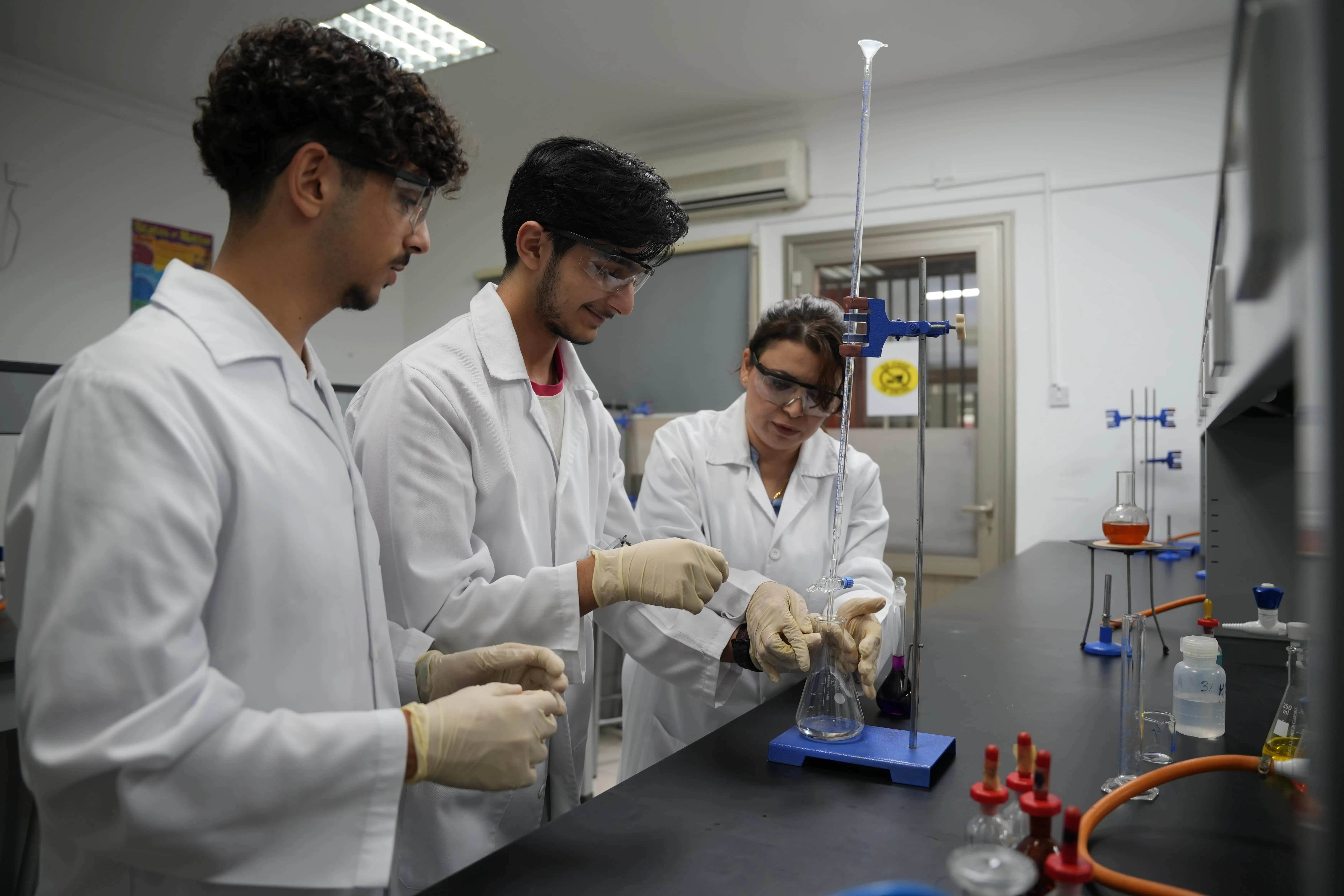
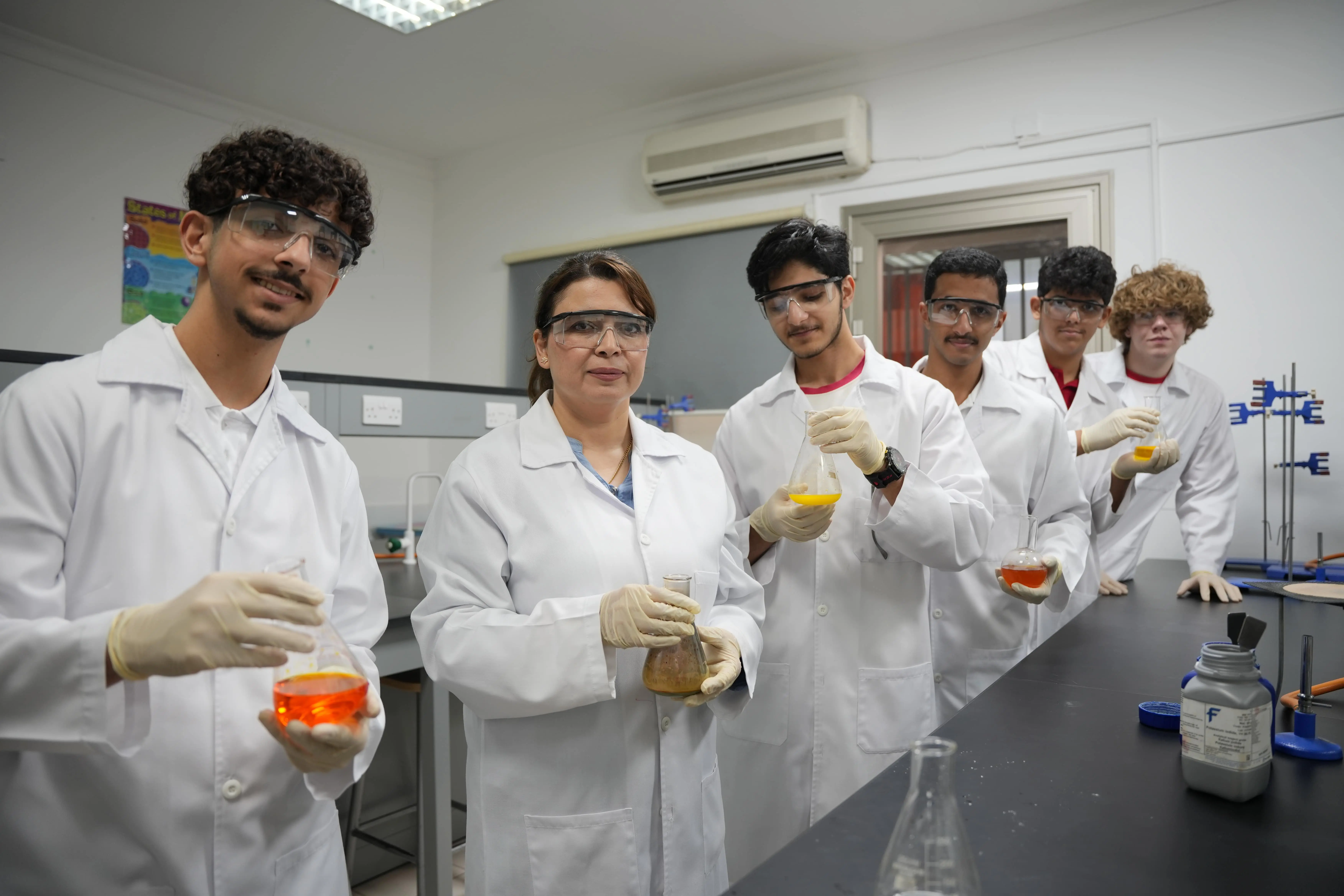
High school years are those 4 memorable life-changing years in everyone’s life. Here at CBS, we work hard to ensure our high school students (Grades 9-12) have the best academic experience and career guidance to make sure they achieve their goals and succeed in higher education and life. Our students are challenged to think critically and creatively through the balanced curriculum and extra-curricular activities.


At CBS, our students learn to recognize the connections between academic disciplines and applications to the outside world. Skills and concepts are not taught in isolation, students and staff collaborate to form a highly connected community of learners.


CBS adopts an American based curriculum in Math (Calculus and Pre-calculus), Science (Biology, Chemistry and Physics), English, Business subjects, Pe and Art. We follow the Kuwaiti Ministry of education curricula in Arabic, Islamic and Kuwait Social Studies.


At CBS, we encourage all students to get involved in extra-curricular activities where it is sports, after-school clubs, student council, or involvement in other CBS and community activities that can help students grow emotionally, socially, and physically

The guidance counselor conducts an information session with students and parents regarding the importance of marks accumulating towards graduation from Grades 9-12 and regarding the completion of Community Service Hours.
Aligned to CCSS RL.9-10.1-10, RI.9-10.1-10, W.9-10.1-10, SL.9-10.1-6, and L.9-10.1-6. Students make inferences, analyze complex characters and plot development, determine themes, compare texts and universal themes, interpret Shakespearean language and symbolism, analyze tone and figurative expressions, write literary analyses, creative narratives, and reflective pieces, and perform dramatic readings.
Aligned to CCSS HSN (High School Number and Quantity), HSA (High School Algebra), HSF (High School Functions), HSG (High School Geometry), and HSS (High School Statistics and Probability). Students solve literal equations and compound inequalities, transform linear functions, work with arithmetic sequences, graph systems of equations and inequalities, evaluate absolute value and piecewise functions, work with exponential and quadratic functions, apply inverse functions, and interpret two-way frequency tables.
Aligned to NGSS HS-LS (High School Life Science) performance expectations. Students explain cell theory and organelle function, describe diffusion/osmosis and active transport, analyze the cell cycle and mitosis, compare asexual and sexual reproduction, trace energy flow through ecosystems, model biogeochemical cycles, analyze population dynamics and succession, explain climate and biome distribution, evaluate human environmental impacts, and classify diversity of microorganisms, protists, fungi, and plants.
Aligned to National Geography Standards and C3 Framework. Students analyze spatial patterns and human-environment interactions, identify types of industrial systems and employment structures, evaluate positive and negative impacts of tourism, explore archaeological connections between past and present, understand labor history, evaluate objectives of international organizations, and distinguish between weather and climate while examining ecosystem distribution.
Aligned to ISTE Standards for digital literacy and creative use of technology. Students demonstrate proficiency in word processing, presentation software, and other digital tools (Techno Book and Techno Painter projects).
Analyze literary elements, develop narrative and analytical writing, engage in discussions, and strengthen vocabulary.
Apply geometric concepts, explore probability and trigonometry, and prove theorems using logic and construction.
Understand atomic structure, bonding, periodic trends, stoichiometry, and chemical reactions.
CCSS.ELA-Literacy.RL.9-10.1–10.10 (analyzing text evidence, themes, and structure) and CCSS.ELA-Literacy.W.9-10.1–10.9 (argumentative and analytical writing).
CCSS.Math.Content.HSG.CO (Congruence), HSG.SRT (Similarity, Right Triangles, and Trigonometry), HSS.CP (Conditional Probability), HSG.GPE (Geometric Proofs).
Aligned with NGSS HS-PS1 (Matter and Its Interactions) emphasizing inquiry, analysis, and evidence-based reasoning.
Deepen literary analysis (Hamlet, Tuesdays with Morrie), evaluate rhetoric and structure, and write extended essays supported by evidence.
Analyze quadratic, polynomial, exponential, and trigonometric functions; apply compound interest and annuity formulas.
Investigate acids and bases, thermodynamics, kinetics, equilibrium, and electrochemistry through quantitative and experimental learning.
CCSS.ELA-Literacy.RL.11-12.1–12.6 (theme, word choice, author’s purpose), CCSS.ELA-Literacy.W.11-12.2–12.9 (argumentative, informative, and research writing).
CCSS.Math.Content.HSF.IF (Interpreting Functions), HSA.CED (Creating Equations), HSF.BF (Building Functions), HSF.TF (Trigonometric Functions).
NGSS HS-PS3 (Energy), HS-PS2 (Motion and Stability), HS-PS1 (Chemical Reactions), emphasizing laboratory precision and problem-solving.
Master essay writing, evaluate themes in classic and modern texts (Othello, Brown Girl Dreaming), and communicate ideas with academic integrity.
Apply calculus principles (derivatives, rates of change), data analysis, probability, and statistics to real-world contexts.
Explore genetics, homeostasis, electromagnetism, and energy transformations through experimentation and modeling.
CCSS.ELA-Literacy.RI.11-12.7–12.10 and W.11-12.1–12.9 (synthesis of multiple sources, analytical and research writing).
CCSS.Math.Content.HSF.IF.7 (graph analysis), HSF.BF.4 (inverse and composite functions), HSS.ID (Interpreting Data), HSS.CP (Conditional Probability).
NGSS HS-LS1 (Molecular and Cellular Processes), HS-LS3 (Genetics), HS PS2 (Electricity and Magnetism), promoting analytical experimentation and critical reasoning.









Block 2, Zaid Al-Khalil Street, Ibn Hesham Kindergarten Building, P.O BOX 1251, South Khaitan, Kuwait.